Peruvian Andes High Altitude Photography: Survival of the Fittest

Have you ever decided to take a 14 day trip to a foreign country with a group of 18 total strangers, save one you have met briefly for half a day’s time? If you were to ask me if I would do it today, the answer would be a hard NO! Yet, at a time in my not too distant past, I said yes, spending two weeks in the highlands of the Andes traveling with people I had never previously met, exploring the many culturally relevant sites of Peru, including the Historic Sanctuary of Machu Picchu. Sometimes you just have to grab the serendipity by the horns, and go for it, and never look back!
So when a spot opened up for the trip, and the leader of the group invited me to join them, all I could say was YES. The next thing I knew I was loading up my camera gear, packing my bags, and boarding a plane headed to Cusco, Peru, with an open mind and joy filled heart, ready to explore new indigenous lands and cultures and the wild inhabitants of their high altitude ecosystems.
The Gear
My camera gear at the time consisted of my Canon 30D and a Sigma 150-500mm f5-6.3 optical image stabilization lens, coupled with my Swarovski EL 10x42 binoculars, and my trusty long telescopic monopod to help with both stability and the weight distribution of the long lens. A monopod can be quite helpful once you learn how to balance the lens and camera while making quick adjustments when shooting birds, as they can be quite challenging to capture. I was extremely grateful to have it, as the trip entailed quite a bit of trekking, and it let me rest the rig on my shoulder through the long days.
Cusco: The Jewel of the Andes
Flying into Cusco at over 11,000’ elevation was truly a sight to behold. Stepping off the plane into the crisp cold air sent a shot of adrenaline through every cell in my body. I knew instantly this was going to be the high altitude adventure of my life, and that premonition proved even more true than I could have imagined. The town square was buzzing with colorfully clad local indigenous people selling their artwork, textile goods, jewelry, and food, as upbeat music created a festive tone for all to enjoy.
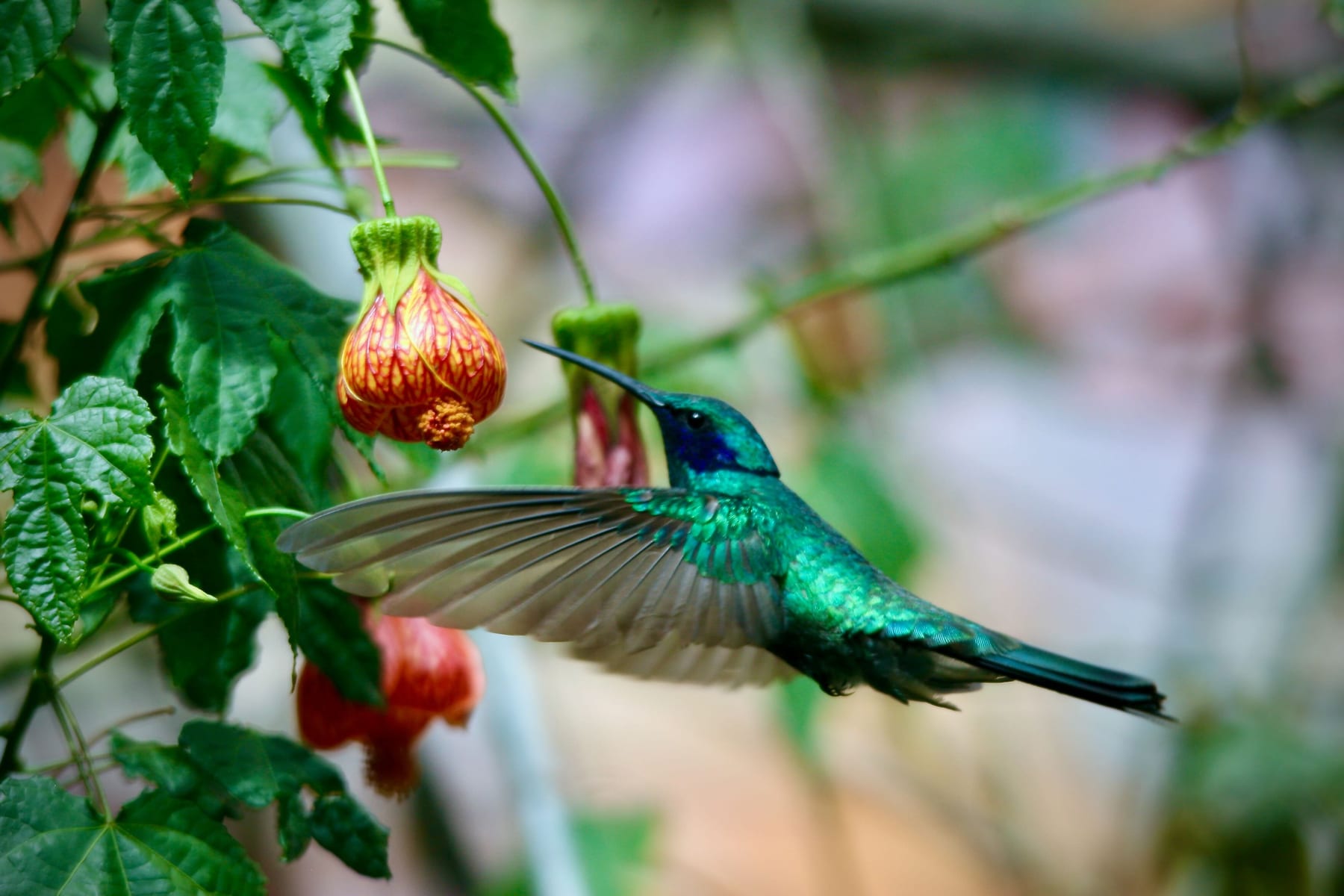
I was soon eternally grateful, as I was able to photograph the strikingly beautiful jewel of the Andes, the Lesser Violetear. An emerald green beauty with a much larger body than our common Anna’s and Allen’s hummingbirds, it hovers with wings beating much slower than their North American cousins, even though the fuel sources are similar. What a great beginning to my high altitude Andean adventure.
Ten Days on the Road
For the next 10 days my 18 new friends and I traveled on a medium sized luxury bus along the high altitude Andes Mountain roads, each in search of our own self realization experience. This was not a birdwatching expedition focused on species lists and endemic checkoffs. It was an adventure without expectations, one where I was unassuming yet eager to experience the NOW, with an open mind ready for whatever materialized in front of me. A truly free and optimistic energy flowed throughout the group. While we were all on our own spiritual path, mine was one of self discovery and soul searching, and grounding in a high altitude ecosystem offering new untethered experiences was the perfect recipe for growth.
Abra Patapampa
The highest elevation of the trip, and the highest I had ever experienced in my lifetime, was the Abra Patapampa (also known as the Mirador de los Andes), a high-altitude mountain pass and viewpoint in the Caylloma Province of the Arequipa Region in southern Peru. We stopped to experience the altitude amongst the local natives, all colorfully clad in celebratory outfits spun from the wool of their native alpacas and llamas.
With the elevation topping 16,000’, the thin, cold, crisp air began to cause some of us lightheadedness and dizziness. The locals offered and demonstrated the chewing of coca leaves to help alleviate any negative energy and ill feelings. Everyone survived the high altitude, including me, which brings me to the two bird species that had the most impact on me from a photographer’s up close and personal viewpoint.
Two Ends of the Spectrum
The Andean Condor, Vultur gryphus, was photographed at an altitude of over 12,000’. The Many-colored Rush Tyrant was photographed at Lake Titicaca at over 12,500’. Although the Andean Condor does not have the largest wingspan of all birds at up to 10.8’, it is the heaviest and largest land bird capable of flight, measuring up to 48” and weighing up to 33 pounds.
The Many-colored Rush Tyrant is at the other end of the spectrum, measuring a diminutive 4” and weighing 6.5-8 grams, or up to 0.28 ounces.
The Starburst of Lake Titicaca
What Tachuris rubrigastra alticola lacked in size, it more than made up for with a striking palette of 8-9 diverse colors. Depending on the ornithological breakdown, a golden-yellow forms the superciliary stripe, distinct from the brighter yellow on its belly. Ochraceous (tan-orange-brown) forms a distinct band across the nape right before the green back begins.
The dominant seven colors consist of:
- Bright yellow covering the entire lower half of the bird from the chest down across the belly and flanks.
- Vibrant green dominating the upper body, covering the entire back, mantle, and rump.
- Deep blue making up the wide facial mask sweeping across the cheeks and surrounding the eyes.
- A fiery red crest patch on top of the crown, which may be concealed unless the feathers are raised.
- A jet black collar band across the chest, and a sharp line running over the center of the head, while heavily marking the wings.
- A bright white highlighting the throat, forming bold horizontal bars across the wings, and bordering the outer edges of the tail feathers.
- The warm brown iris of the eye completing the contrast against the blue facial mask.
Combine the first two with the dominant seven and you have 9 different colors in a small 4” package, the starburst of Lake Titicaca.
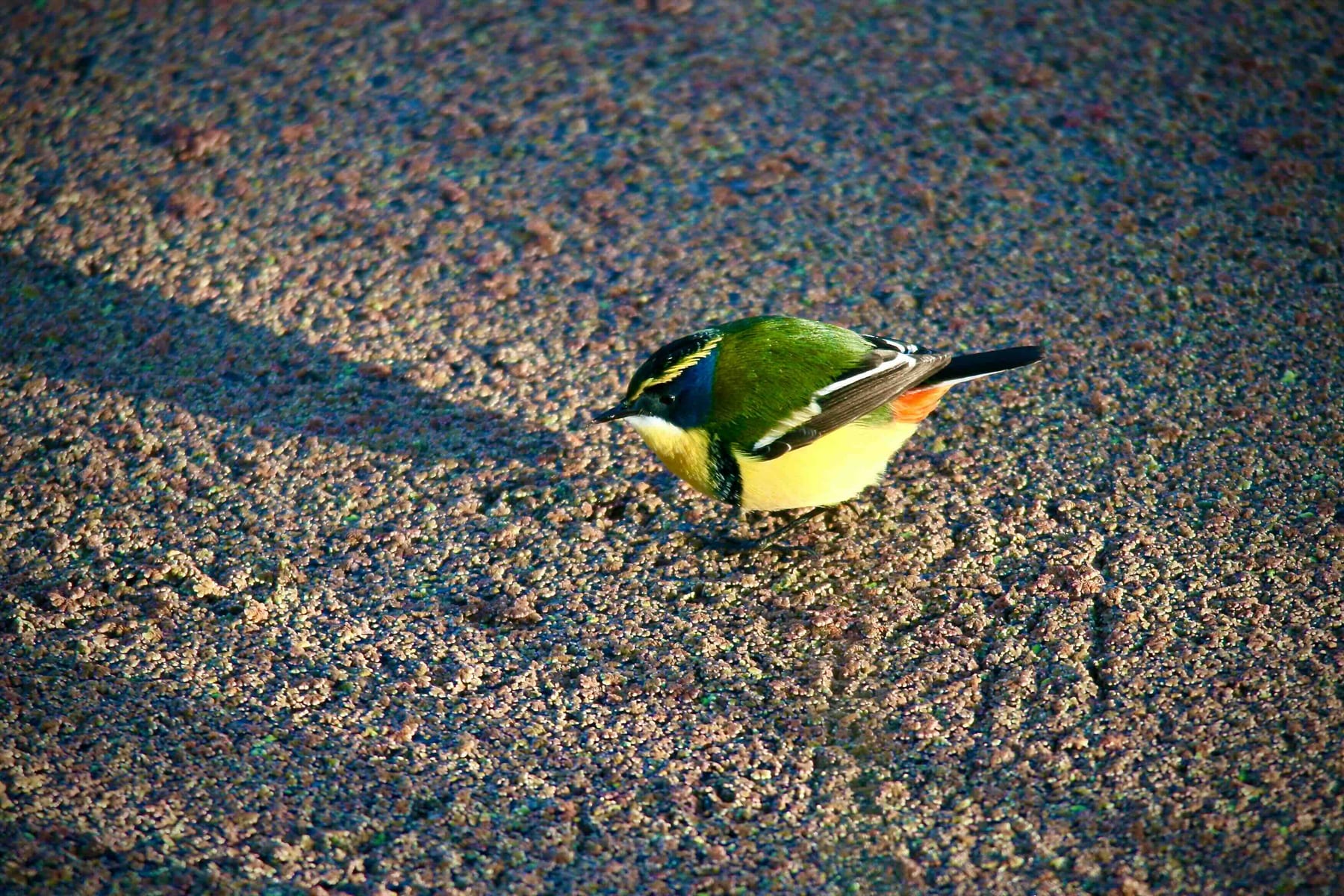
I was fortunate at the end of the trip to spend two days photographing this special creature. With some great early morning light at times, I was able to document its foraging and the acrobatic maneuvers it uses to catch prey. Their diet consists of 50% dragonflies, along with small flies, beetles, bugs and spiders found clinging to marsh plants. These birds hop and hang upside down on the reeds, gleaning insects directly off the vegetation and even the water’s surface. Their gymnastics entertained me for hours, as I could not get enough of their dazzling maneuvers and tricks as they put on quite the display for me and my lens!
Speaking of lenses, it’s time to switch birds and head over to the other end of the avian size spectrum, the Andean Condor.
The Andean Condor
These soaring giants put on a very contrasting show, both in activity and in plumage, donning a more formal attire likened to a tuxedo. Looking down on them as they climb the canyon walls, their dark body is flanked by bright white wing coverts and inner remiges, with a large white neck ruff designed to keep the cold alpine winds at bay. They looked like something out of a 1500s Elizabethan painting, soaring on the thermals up to our viewing corridor, where we waited with cameras pointed and ready to record the ballet in the sky of these magnificent creatures.
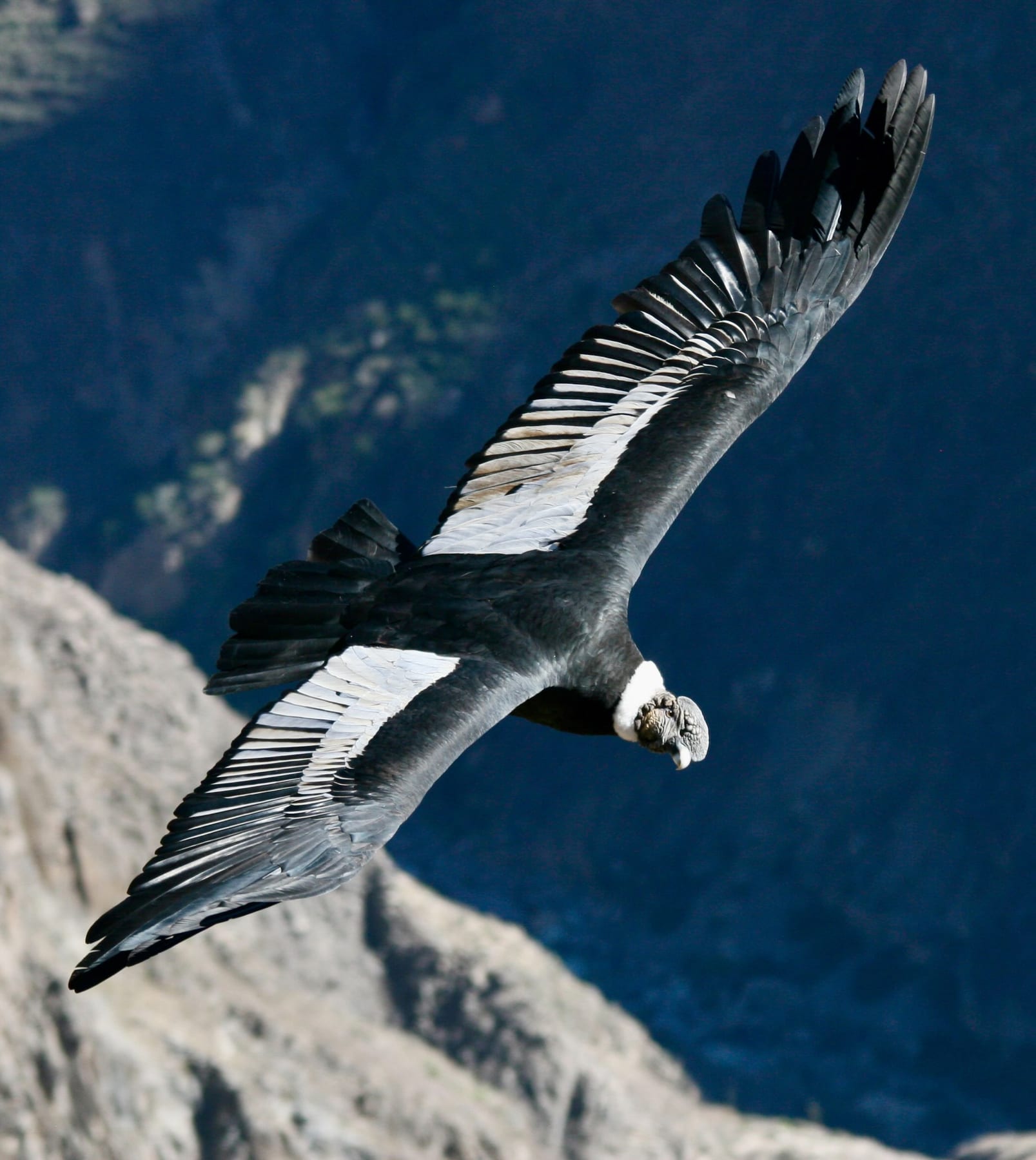
The Vultur gryphus displays significant sexual dimorphism. The males feature a large, prominent, fleshy crest or comb known as a caruncle over the crown of the head, and a loose, hanging wattle along the throat. Females do not exhibit these features and have smooth bald heads. Both lack feathers in this region due to their habit of exploring inside carcasses, where bacteria could cling to feathers and cause sickness. The eyes are also different: females have distinct red eyes while males typically have brown or yellow eyes.
As for photographing these giants, it was a challenge to encapsulate their entire body whilst they soared by at speeds difficult to freeze in the frame.
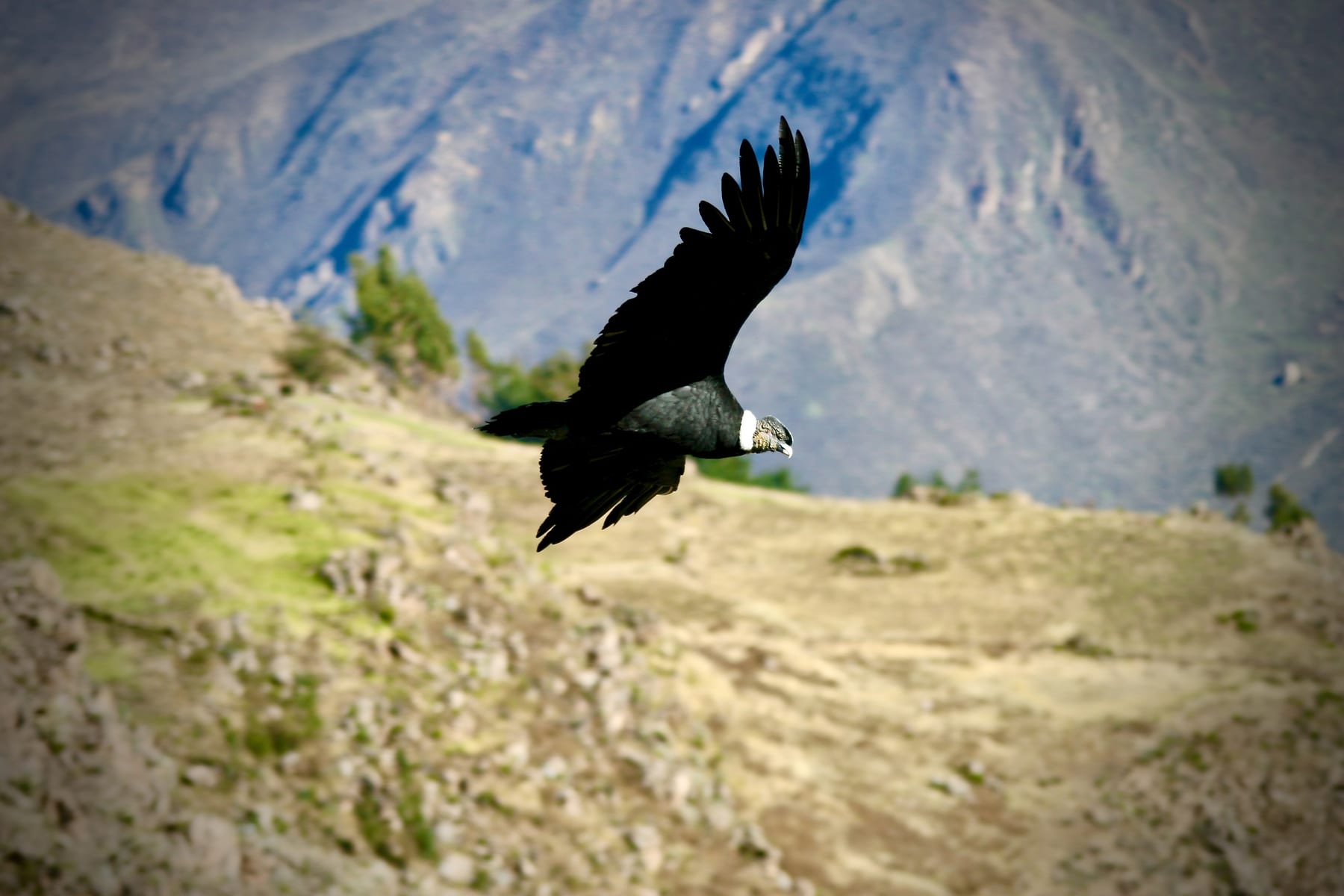
I ended up shooting over 500 images and am still processing many, taking my time to pick and choose the best shots to share. Keep checking the website as I will be posting some new ones soon.
Survival of the Fittest
For now we must address the difficult task of conserving these valuable living resources, in the midst of a struggle for survival, both of these birds and of the people trying to make a living in the high altitude world of the Andes.
The illegal wild bird trade has been a problem for many years in Peru. Ever since the ecotourism movement began, it has helped shift the financial value of native birds from commodities to protected, living assets. Peru has over 2,000 species of birds, making it a premier global destination for birdwatching tourism. It has also shifted local perspectives, as people learn there is much more sustainable long term financial security in protecting rare endemic species than in trapping and selling them to the illegal pet trade.
- Employment opportunities for locals in the eco trades are increasing, as models like Rainforest Expeditions partner with indigenous families as shareholders, significantly boosting local incomes and removing the economic desperation that drives wildlife trafficking.
- The uptick in human presence on birding trails and at eco lodges is a passive deterrent for poachers who do not want to be seen.
- Ecotourism revenues help local associations secure legal conservation concessions, which can prevent unauthorized access and illegal poaching.
- Communities can create geographical strongholds where prized endemic populations are heavily guarded, due to their immense value to visiting birders trying to fill out their life lists.
A win, win outcome for both the avian and human world! Please help me support these ecotourism organizations as well as the indigenous communities. Every purchase you make triggers a 10% donation to the conservation area where the print was photographed.
Enjoy the journey, Richard Mexico